Centennial west street, ancient architecture exhibition hall
West street road "one vertical and four horizontal", "width alley", such as chengdu into the west street, is slip away out of tujia diaojiao building along the street and cornices become warped foot hui style architecture, but also many temples in ordinary fireworks with a hint of the dust. Nowadays, most of the ancient meanings are in the dust, and these buildings are in the long history of the river, in a quiet and leisurely manner inheriting the west street's centuries-old culture.
Many people think that a person has a person's personality, a building has the nature of a building, and has the flavor of a street, a street is the neighborhood of the streets, and even a small shop, it is these different things, to make a street with soul.
West street intersection interlinked lies between the lanes of countless was a hall with high ceiling palace, makes their streets deducing the mountain once the history and the humanities today, every street lane has its unique story. When you walk into the old street, you touch the wall of the old street with your hands and feel the past and present.

The stilts and huizhou buildings, two architectural styles of strange fusion
Walking into west street, the white walls and black tiles of the cape, and the empty wooden buildings that spread out along the street, came into view. The two styles of architecture have two prominent names in architecture: the huizhou architecture and the stilts.
Xiushan originally was the place where the tujia and miao people live together, the first inhabitants of west street were mostly local people, so it was a logical thing to have the balcony here. As a common form of living room, it is found in the mountains and waters of southeast chongqing. Attaches great importance to the dragon vein, tujia diaojiao building more leaning, strewn at random have send a tiger sitting up to the mountain, with "left tsing lung, right white tiger, QianZhuQiao, after basaltic" as the best WuChang, god coexistence, embrace the natural universe. Later, Orient toward, or sit west to east, or sit east to west. And the condole of west street is precisely according to this kind of layout to build.
The diaojiao building belongs to the category of that building, namely "size is larger, the houses built on stilts, the house spreads board for living" (ZhuangYuGuang "dry railing buildings"), in the rain, wet wuling mountain area is highly advantageous to moisture and ventilation, is considered by the modern architect is the best form of ecological architecture.
The ceiling of the west street is mostly flat, and the entire structure of the ceiling is tenon and tenon, and it looks as if it was put on. The floor of the ceiling was pieced together by pieces of wood. A lot of foreign tourists go up to the foot of the condole building some shiver, always afraid the house will coax a collapse. As a matter of fact, many of the houses have been baptized by the hundreds of years of rain and rain.
If the balcony is the best embodiment of the local style building in the west street, the microstructure is the perfect fusion of the foreign style architecture and the west street. It is well known that the microstructure originated in the ancient huizhou, and the most obvious is the white wall black tile and the high wall around the house, which is called the "fire wall".
So how did the huizhou architecture get into west street?
This has to do with the history of the hui merchants. After the middle of the Ming dynasty. Huishang began to rise and culminated in the qing dynasty, when the hui merchants traveled all over the country, and they were able to see the presence of huishang as long as there was a place to buy and sell. During the reign of emperor guangxu of the qing dynasty, many hui merchants engaged in the trade of tung oil, private cloth and salt tea came to xiushan and chose to open trade Numbers here and trade in bulk goods. In the city of xiushan, there were a number of famous traders, such as "colleagues and", "ruithai and", "together with tai-tai" and "yongsheng long". These hui merchants were known as "jiangxi gang" by the xiushan people, and after they had settled down here, they introduced the huizhou buildings to xiushan. West street, as the site of the time, naturally built many huizhou buildings.
Now walking on west street, the high wall of the stilted building and the head of the horse's head are strewn with the wrong and the other, and between each other, the black tile white wall and the log air pavilion collide each other, forming elegant and generous colors. The courtyard on both sides of the street was deep, and the steps were stained with green moss and old marks. From the old to the present. These ancient buildings look like the hourglass of time, slowly dripping down the long history, filled with the tenderness that allows time to linger, tentacles and tenderness.

Mysterious palace of heaven
An ancient theater of drama
Xiushan county, the city's business also started to develop, with the prosperity of economy, more and more foreign businessmen begin to enter the mountain, the people in the mountain has established various temples, chenghuang temple, Confucian temple, guanque tower, temple, flower drum, sichuan and the main temple, goddess of mercy pavilion, temple of fire, correlation and cat cat pavilion (zhao guanque tower), etc.
Among them, the most interesting should be the palace of the heaven, because it is an exotic temple to worship a god who is not associated with the inland.
As is known to all, in the temple worship, is called a matsu gods, and mazu is also called the day, days and days of Notre Dame, navigation is the southeast coastal area, travelers, businessmen, seafarers and fishermen common belief in gods, is a water pipe. In ancient times, ships were to worship mazu before sailing to sea, and to protect the wind and safety of the ship.
Why, then, are the spirits of a coastal region erected in the southwestern county of the county? This is related to the developed trade environment at the time. In the middle of the 18th century, China was under the reign of emperor qianlong, and commerce and trade activities were very frequent throughout the country. At that time, the water transportation in fujian was very developed, and some of the fujian hakkas did not only develop the ocean trade, but also followed the inland water system and entered the mainland for trade. As a result, some fujian people continued to swim upstream after arriving in the yuanjiang river basin, entering the plum river and then arriving at xiushan city.
Later, some of these fujian people settled down in xiushan, producing children and breeding, forming a certain area of concentration in xiushan. The fujian people who settled in xiushan district raised money to build mazu temple, and as a pavilion of fujian, it was a kind of spiritual support and shelter for the residents, and also a place for the reunion of the villagers.
The mountain city, in the river there are many places where people, they think of mazu since water is the gods, that both Marine and inland river, can bless them, so will come and worship. Later, the temple of heaven added a stage for worship service. Gradually, the palace is a place of worship and blessing.
The fifties and sixties of the last century, xiushan lantern dance troupe formed after, who will be performing here as a place that is on the stage on a regular basis lantern show, is very popular among the masses, at the feast and the rounds, is packed to watch people, is "ancient stay theatre". However, in a lightning accident, the fire was burned down, and the place that carried the cultural heritage of xiushan was annihilated.
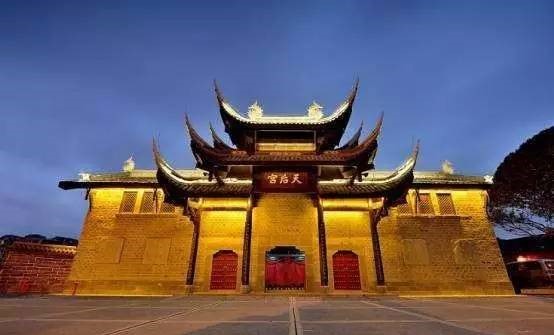
Today, the palace of heaven, as a cultural landmark of west street, has been rebuilt. In the reconstruction plan, combining the site environment, the dynamic visual viewing points are created. Completely healed the queen of heaven, and provides a colorful variety of display link, is a collection of teahouse stage, folk culture exhibition, cultural relics collection, business and leisure, folk culture activities, and other functions in a body's comprehensive museum.
Presumably, it won't be long before the palace will ring a Lantern Festival.